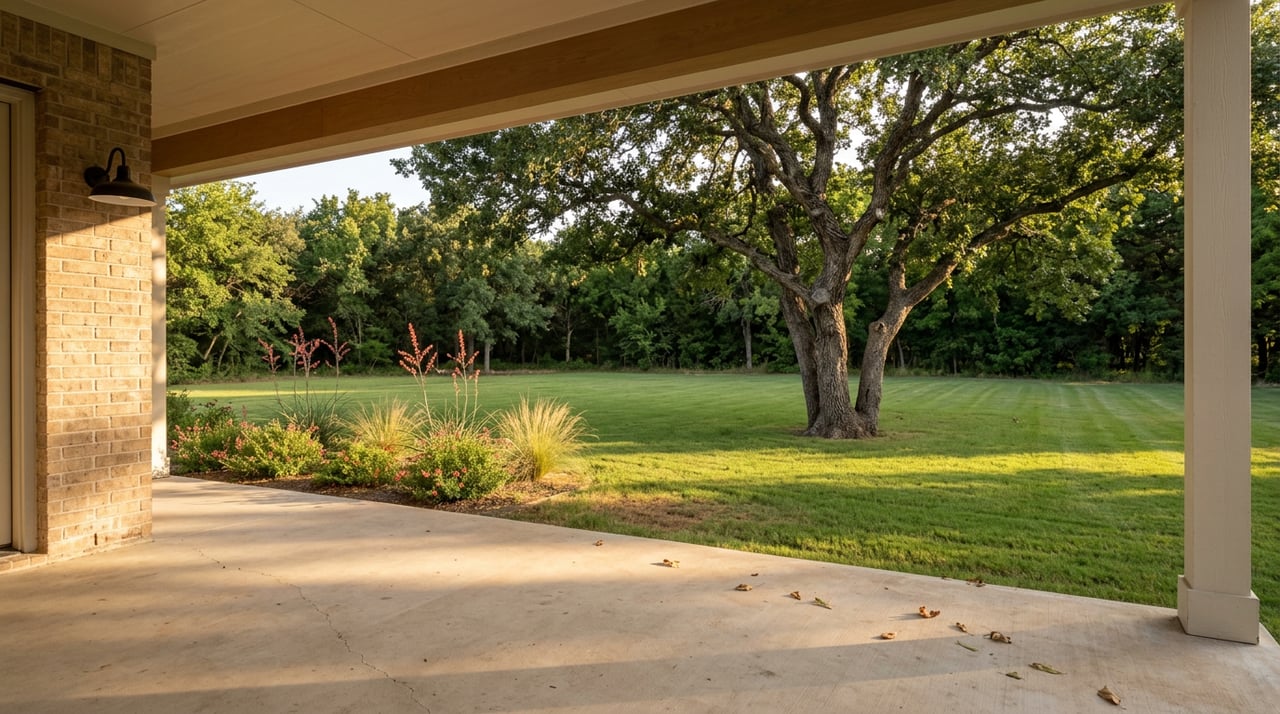
A seller in west Flower Mound calls in June with a clean plan. List after the Fourth of July, close by Labor Day, take the kids on the delayed vacation. There is one thing to handle first. A leaning post oak near the pool needs to come down before showings, and a second oak by the driveway is blocking the elevation shot the photographer wants.
Both are specimen trees under Town of Flower Mound code. The plan just lost about six weeks, and the seller has not made a single call yet.
This is the friction almost no pre-listing checklist in Flower Mound accounts for. In a market where buyers already have room to walk, the Environmental Conservation Commission calendar can quietly reprice a listing that looked ready to go.
The clock most sellers do not know is running
Chapter 94 of the Flower Mound Land Development Regulations is the town's tree preservation ordinance. It protects four categories of trees on private residential lots: protected, specimen, majestic, and historic. Removing any of them requires a tree removal permit issued through the Environmental Conservation Commission, and the application has to come from an ISA Certified Arborist or a Certified Forester. A homeowner cannot file it themselves.
For a truly non-protected residential tree, no permit is needed. That is the exception most sellers hear about first, and it is why the ordinance catches people. The trees Flower Mound cares about are exactly the ones that make the listing photos work: mature post oaks, blackjack oaks, cedar elms, and other native canopy species that grew in before the subdivision did.
The town's stated purpose is to prevent clear-cutting and preserve the wooded character that gives Flower Mound its price premium in the first place. The full ordinance text is public, and reading it before you list is roughly a $200,000 exercise if your closing date depends on it.
The ECC calendar, in real weeks
Here is the sequence a permit actually moves through. Not a bullet list of definitions, but the calendar a seller has to work backward from.
- Week zero. Hire an ISA-certified arborist to survey the trees, identify which are protected, and prepare the application. Photographs from the street are required for every tree proposed for removal.
- Week one. Submit the tree removal permit application. It must be received at least 30 days before the ECC hearing you are aiming for. The ECC meets on the first Tuesday of each month.
- Weeks two through five. The town confirms how many public-notification signs your project requires and produces them. Signs are $200 each. The fee to consider a specimen or historic tree for removal is $250 per tree, capped at $1,000 per application.
- Week three, at the latest. Pick up the signs from Environmental Services at 201 Spinks and post them on the property, perpendicular to the street, at least 15 days before the hearing. Neighbors can now see, in writing, that you are asking to remove trees.
- Hearing night, first Tuesday. The ECC considers the request. Public comment is on the record. If neighbors show up, the tone of the room matters.
- After approval. Removal can proceed, subject to any mitigation the town assigns. Replacement trees are calculated per caliper inch against a value schedule the town maintains, and mitigation is enforceable against the property owner.
That is a 45 to 60 day window from the first arborist call to a chainsaw in the yard, assuming everything is clean. If the application misses the 30-day cutoff by a week, the next available hearing is a month later.
Two real examples give the shape of what the ECC actually reviews. In May 2024, the town council approved a permit for the removal of 117 specimen trees on the 447-acre Smith Tract Conservation development, brought forward by Toll Brothers, as reported by Community Impact. That is the scale end. At the other end, in June 2025, the commission spent a full hearing on a single 23-inch specimen post oak on a 0.76-acre lot on Overlook Ridge, with a neighbor addressing the commission by name and the applicant, Bentovia Custom Homes, explaining why the septic layout on the lot limited its options. One tree. One hearing. One public comment period.
Assume your case is closer to the second.
The three moments this catches sellers
Before the listing goes up
The most expensive version of this mistake is the quietest one. A seller decides to tidy the lot before photos, tells the lawn crew to take down the sad-looking oak in the corner, and lists two weeks later. If that oak was protected, the town has the authority to impose civil penalties on the property owner and to require replacement trees valued on the per-caliper-inch schedule. Neighbors report these removals. Aerial imagery makes them provable years later. It is not a risk that ages well through a title search.
The safer sequence is to get an ISA-certified arborist on the property before you touch anything. If the tree is genuinely dead, dying, or a hazard, the arborist's documentation is what the town wants to see. If it is healthy, the ordinance is the reason to leave it and market around it.
During the option period
The second moment shows up after you are under contract. A buyer's inspection flags a large limb over the roof, or the buyer wants a written assurance that a specific tree near the foundation will come out before closing. Now the 45 to 60 day permit clock is running against a 30-day option and a 45-day close. The negotiation is no longer about who pays for the removal. It is about whether the deal survives the ECC calendar.
Two options usually save these transactions: a repair credit at closing so the buyer manages the permit after they own the home, or a clean written acknowledgment that the tree is protected and stays. Sellers who promise removal by closing without checking the calendar are the ones who end up extending, and extensions in the current market invite renegotiation on price.
When the buyer wants a pool, addition, or new driveway
Custom-home and move-up buyers frequently write offers assuming they can put a pool in the backyard by next summer. In Flower Mound, if the pool footprint touches protected trees, that pool waits on the ECC. On lots not connected to town sewer, where the septic field already claims a significant chunk of the backyard, the constraint is even tighter. The Overlook Ridge hearing turned on exactly that point, with the builder explaining that on-site septic infrastructure occupied enough of the yard that designing around the specimen tree was not workable.
If your listing markets a "pool-ready backyard" or an "expandable footprint," those phrases deserve a tree survey behind them before they go into the description.
What the current market does to a 45-day detour
Two years ago, a permit-driven delay was a nuisance. In 2026, it is a pricing event.
Flower Mound's median sale price sat at $620,000 in March 2026, down 4.6 percent year over year, according to Redfin's market data. Homes were selling in around 25 days on that dataset. A separate 30-day snapshot from Orchard, closer to early summer 2026, showed a median around $588,000 with a median 54 days on market, up from 27 the year before, and 45 percent of active listings dropping price at least once. The sale-to-list ratio sat near 95 percent.
Read those numbers together and the picture is not complicated. Buyers have room. They are taking longer to decide. Almost half of sellers are cutting price to move. In that market, a 45-day permit detour that pushes a listing from early summer into late summer usually costs the seller a price reduction, not just carrying costs. The math is roughly one round of mortgage, tax, and insurance payments, plus the price reduction buyers ask for once the days-on-market number crosses into the second bucket on the search filters.
None of that shows up in a builder's spec sheet or a portal's median price. It is entirely a Flower Mound-specific line item that only surfaces when someone actually runs the transaction.
A pre-listing tree audit worth doing before the sign goes in the yard
If your Flower Mound home has any mature canopy in the front, side, or rear yard, this is a two-hour investment that pays for itself the first time it saves a deal.
- Walk the lot with an ISA-certified arborist and identify anything at protected, specimen, majestic, or historic size. TreeNewal and Tree Service Flower Mound both hold ISA credentials and work in town regularly.
- Ask specifically about health: any tree that shows epicormic growth, significant decay, or storm damage should be documented in writing.
- If a removal is warranted, file the permit before you list, not after you are under contract. The 30-day submittal, 15-day sign posting, and monthly ECC calendar are known. The buyer pool and option period are not.
- If a removal is not warranted, incorporate the tree into the listing narrative. Mature native canopy is a Flower Mound premium, not a defect.
- Check HOA covenants and any conservation easement recorded against the lot. Some neighborhoods add a layer of restriction on top of the town ordinance.
- Confirm sewer status. Homes on septic have less backyard flexibility, and that constraint interacts directly with tree preservation.
Do this in the season before you plan to list. The one thing the ECC does not offer is a fast track.
FAQ
Does every tree in Flower Mound need a permit to remove? No. The ordinance protects specific size and species classes: protected, specimen, majestic, and historic. Smaller ornamentals and non-native trees outside those thresholds usually do not require a permit. An ISA-certified arborist can tell you which category each tree falls into after a site visit.
Can I remove a dead or hazardous tree without going through the ECC? Documentation matters more than urgency here. Written findings from a certified arborist that a protected tree is dead, dying, or an imminent hazard are what the town looks for. Skipping the process on a healthy protected tree, even one that "looks bad," is the version that triggers penalties.
What does mitigation actually cost if a tree comes out? The town maintains a per-caliper-inch cash value for replacement trees, updated by the tree preservation officer. Replacement can be planted on the same lot or paid as a cash equivalent. Costs vary with tree size and species, and your arborist can pull the current schedule before you commit to a plan.
Should we disclose an active tree permit application to a buyer? Yes. Anything material to the property, including a pending ECC hearing or a signed removal permit that has not been executed, belongs in the seller disclosure and in conversations with your agent. Buyers who learn about it during the option period rather than upfront are the ones who walk.
If you are thinking about listing a Flower Mound home this year and there are mature trees anywhere on the lot, the season before you go live is the right time to have this conversation, not the week the sign goes in. Miranda Realty Team handles the timeline before it becomes a pricing problem. Get Your Free Home Valuation and we will walk your property with the ordinance in mind, not just the comps.
